
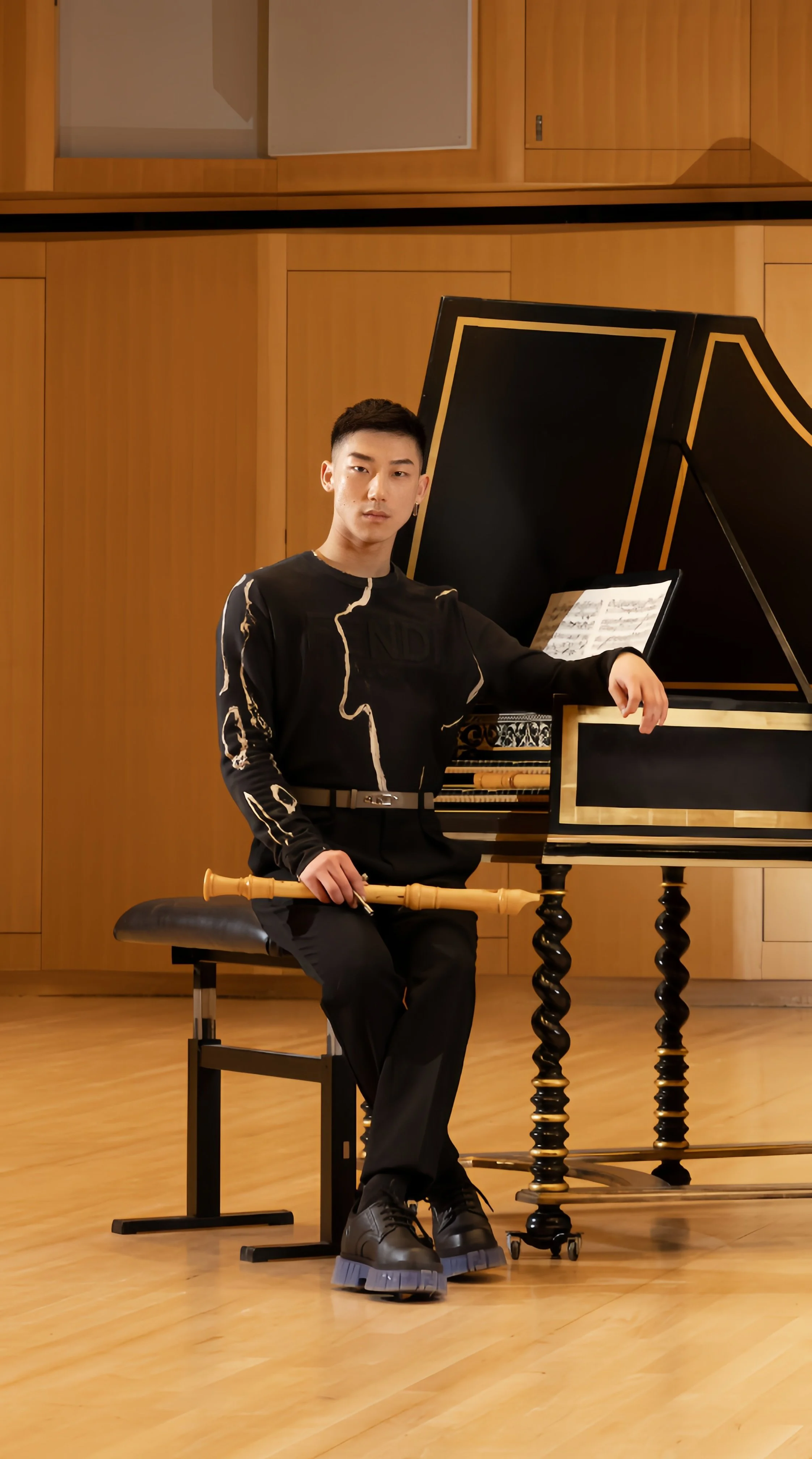
Peter Lim is a harpsichordist and historical woodwinds player, specializing in historically informed performance, currently based in Basel, Switzerland. Active as both a soloist and ensemble musician across Europe and North America, his work centers on the integration of scholarly inquiry and performance practice.
Born in South Korea, Peter began his musical path as a self-taught musician before relocating to the United States at the age of fourteen, initially intending to pursue studies in medicine. This trajectory shifted decisively as he committed to music professionally, leading him to the Oberlin Conservatory, where he studied with Mark Edwards (harpsichord) and Michael Lynn (recorder). His growing engagement with early music eventually led him to Europe, where he continued his studies in the Royal Conservatory of Brussels, under the tutelage of Bart Naessens (harpsichord), Marcel Ponseele (historical oboe), and Bart Coen (recorder).
He subsequently returned to the United States to pursue further studies at The Juilliard School’s Historical Performance program, under the direction of Robert Mealy, where he further developed his artistic profile as a harpsichordist, studying with Peter Sykes, Richard Egarr, and Béatrice Martin. Upon the completion of his studies in NYC, he returned to Europe to study at the Schola Cantorum Basiliensis in Basel, Switzerland, where he completed his principal studies in harpsichord with Francesco Corti, alongside a minor in recorder with Andreas Böhlen. He is currently enrolled in a specialized master’s program at the Schola Cantorum Basiliensis, with a focus on advancing his work as both a harpsichordist and ensemble director.
As a performer, Peter has appeared in both solo and ensemble settings, collaborating with leading period-instrument ensembles including Handel and Haydn Society, Atlanta Baroque Orchestra, and Apollo’s Fire. In chamber contexts, he is active as a co-artistic member of ensembles such as ChamberQueer and The Broken Consort, through which he explores innovative programming and collaborative artistic direction. His solo work often emphasizes lesser-known repertories, with particular attention to regional styles and historically grounded performance conventions.
Alongside his performance career, Peter engages deeply with the scholarly dimensions of early music. His work includes the preparation of critical-performance editions drawn from seventeenth- and eighteenth-century manuscript sources, as well as research into the practical application of historical tuning systems. This dual focus informs an approach that prioritizes not only stylistic accuracy, but also the development of viable interpretative frameworks for contemporary performers.
Looking forward, he seeks to further integrate research and performance, strengthening artistic and scholarly exchange between Europe and North America, and contributing to a more nuanced understanding of early music in modern performance contexts.